

The biggest mistake people make when they plan a cross-country move is assuming the car will just sort itself out. The house gets packed, the movers get booked, the utilities get scheduled.. and the vehicle sits in the driveway as an afterthought, like it will somehow teleport to the new place on its own. Then moving week arrives and someone finally does the math: two cars, two drivers, and seventeen hundred miles don’t divide neatly into one weekend.
That is the moment a smooth move quietly turns into a stressful one. So let me walk through how this actually plays out, because the car is almost never the small detail people treat it as.
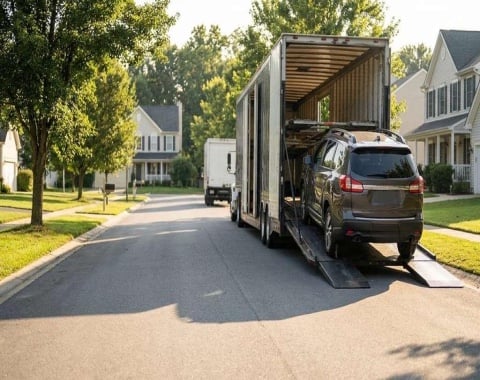
“We’ll just drive it” sounds cheaper than it is
Everybody assumes driving the car themselves is the free option. On paper, it looks that way. No shipping cost, no coordinating with anyone, just you and the open road. But in reality, the drive has a bill attached; it’s just spread out where you don’t notice it all at once.
Think about what a three or four-day haul across the country really adds up to. Gas the entire way. A hotel every night. Food on the road. Maybe a day or two of lost pay because you burned vacation getting there. And that is before you count the wear you just put on the vehicle. A couple thousand more miles, tires closer to done, brakes a little more tired than they were. If two people are caravanning two cars to stay together, now you have doubled the fuel and the fatigue, and slowed the whole convoy down to whoever needs the most rest stops.
None of that shows up as one clean number, so people never compare it honestly. When they finally line it up against having the car moved for them, the gap is a lot smaller than they pictured, and sometimes it flips the other way completely.
The move and the car run on two different clocks
Here is the part that trips people up. They think the car has to arrive the same day the furniture does. It doesn’t. The moving truck and the vehicle are on completely separate schedules, and that is actually good news for you.
When you hand the car to a transport carrier, you get your options back. You can fly to the new city, be there to meet the movers, get the beds built and the fridge stocked, and let the vehicle show up on its own a few days later. You are not chained to a steering wheel for the most stressful stretch of the entire move. A company like Rivalane Auto Transport handles the pickup and the delivery window, so the car becomes one less thing you are personally dragging across the map.
People underestimate how much lighter the whole week feels when you are not also responsible for physically driving a second vehicle through weather, traffic, and highways you have never seen, while the rest of your life is packed in boxes.
Nobody prices a car move the way you expect
The assumption is that shipping a car has a set sticker price, like a plane ticket. You ask, they say a number, done. But that is not how this market runs, and the sooner you understand that, the fewer surprises you deal with later.
The price of a vehicle move rides on a handful of moving parts. Distance is the obvious one, though longer routes usually cost less per mile than short ones, which catches people off guard. Then there is the route itself, how busy that lane is, whether trucks run it constantly or rarely. The size and weight of the vehicle matter too; a lifted truck eats more room on a trailer than a compact sedan. Open transport costs less than enclosed. And timing, the season, and how many carriers happen to be available that week, swing the number more than anything else on the list.
So the same car on the same route can cost different amounts depending on when you book it. That is not a company playing games; that is just a marketplace where trailers fill up, and lanes shift with demand. Getting a real quote close to your actual moving date beats grabbing a lowball figure weeks out that no driver will actually honor.
The check almost everyone skips
Here is the one that genuinely costs people money. They pick whoever answers first with the lowest number, hand over the keys, and never confirm the outfit is even legitimate. Then something goes sideways, and there is nobody real standing behind it.
Any carrier moving a vehicle across state lines has to be registered and insured, and the thing most people don’t realize is that the record is public. You can pull up a company’s federal safety and licensing file in about a minute and see whether they are active, whether their insurance is actually on file, and whether they are who they claim to be. It takes almost no effort, and it quietly filters out the operators you never wanted near your car in the first place.
That single step is often the whole difference between a move that goes fine and one that turns into a claim you can’t collect on. It’s worth the sixty seconds every time.
One last thing
When you build your moving plan, put the car on the list the same day you book the movers, not the night before you pull out of the driveway. The people whose moves go smoothly are rarely the ones who try to do every single thing themselves in one heroic weekend. They are the ones who let the parts that could travel separately travel separately.
We hope you found this blog post Car Is the Part of a Long Distance Move That Wrecks People’s Plans, useful. Be sure to check out our post Safety Tips For Driving With a Loaded Car On Moving Day for more great tips!

Have Experience in the Moving Industry? Want an Additional Income Stream? Work With All Around Moving!
Partner with us, moving relocation consultants, and we’ll help you profit. Click here to learn more about it.