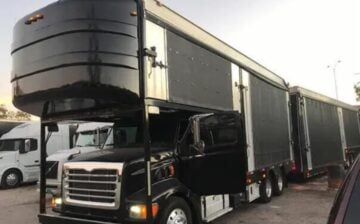

Most people hear “door to door” and picture a giant car hauler rolling right up to their front step, setting the vehicle in the driveway, and pulling away. That’s the image in everyone’s head. And it’s almost never exactly how it goes, especially if you are moving out of a city block or into a tight neighborhood where an eighty-foot truck has nowhere to turn around.
That gap between what people expect and what actually happens is where a lot of moving day stress comes from. So it’s worth understanding what door-to-door really means before the driver calls you, not after the truck is already idling at the end of the street.
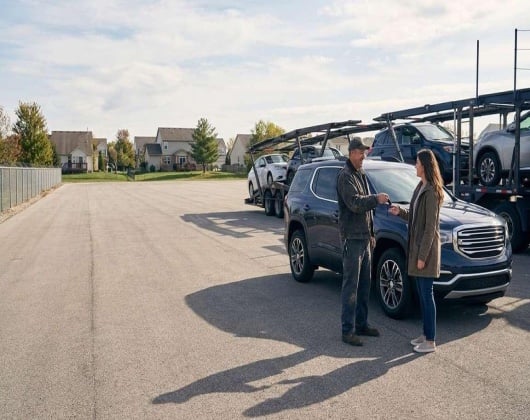
Door-to-door does not mean your exact door
The honest version is this: door-to-door means the carrier gets your car as close to your address as they safely and legally can. Not “into the driveway no matter what.” A full-size car carrier is enormous. It can’t fit down a narrow one-way street, it can’t duck under low branches or a low bridge, and it definitely can’t thread through a packed city block with cars parked bumper to bumper on both sides.
When the street doesn’t work, the driver arranges a nearby spot that does, usually a big open lot like a shopping center or a wide, quiet road a few minutes away. You meet them there, do the handoff, and that’s it. This is completely normal, and it is not the company cutting corners. It’s just physics. That is exactly how door-to-door auto transport is meant to work, and any honest carrier will tell you that up front instead of promising your literal doorstep and then scrambling when the truck arrives.
Once you know that, the whole thing gets simpler. You are not standing around waiting for something that was never physically possible; you are just meeting a truck a short drive away.
Why do people pick it over the terminal option anyway
Some folks assume the cheaper route is to drop the car at a terminal themselves and grab it from another yard on the far end. And sometimes the per-mile number does look lower. But that comparison leaves out everything the terminal option quietly costs you.
Terminal to terminal means you drive the car to a lot before you leave, then figure out how to get from that lot back home without your vehicle. On the other side, you do it all in reverse, finding a ride to some yard in a city you just moved to and don’t know yet. On a week where you are already juggling movers, boxes, and a family that ran out of patience two days ago, those extra errands are the last thing you have room for.
Door-to-door folds all of that away. The car gets collected near where you are and delivered near where you are headed. You trade a slightly higher number for not having to solve two separate transportation puzzles during the worst possible week to be solving puzzles. For most people who are in the middle of a move, that trade isn’t closed.
The access details nobody mentions until the driver is already calling
Here is where these deliveries actually go sideways. The carrier shows up and only then learns the address is a gated community with a low clearance arch, or a cul-de-sac with no room to swing a rig around, or a street the city won’t let a truck that size sit on. Now everybody is improvising, and improvising eats up time nobody has on moving day.
You can head off almost all of it by saying the awkward stuff early. Tell whoever books the move if your street is tight, if there’s an HOA with its own rules, if there’s a low bridge on the only road in, or if parking is a nightmare at both ends. A good dispatcher takes that information and picks the meeting spot before the truck ever rolls, so the pickup and the delivery end up boring instead of chaotic. The moves that fall apart are almost always the ones where nobody mentioned the access problem until the driver was sitting there staring at it.
Boring is exactly what you want here. Boring means it went right.
Make sure you know who is actually pulling up
The last piece people skip is checking who they just handed the keys to. On a moving week its tempting to book the first company with a friendly voice and a low number and move straight on to the next fire. But you are trusting a stranger with a vehicle you will need in a city you don’t even live in yet, so give it a few minutes.
Look the company up before you commit. Their track record, how they deal with complaints, and what real customers say after delivery will tell you far more than any sales pitch. A quick look at a company’s reputation and complaint history usually separates the operations that show up and communicate from the ones that go silent the second your car is on the truck. It costs you almost nothing, and it changes how the entire week feels.
One last thing
When you plan the move, treat the car handoff like any other appointment that needs a real time and a real place, not a vague promise about your driveway. Ask roughly where the meeting spot will be. Give the honest details about both addresses. The people whose car deliveries go smoothly aren’t lucky; they just told the truth about their street before the truck showed up.
We hope you found this blog post on What Does Door-to-Door Car Shipping Mean on Moving Day? useful. Be sure to check out our post on How To Choose The Right Car Shipping Company for more great tips!

Have Experience in the Moving Industry? Want an Additional Income Stream? Work With All Around Moving!
Partner with All Around Moving & join the Work With Us program. We will help you make money by arranging professional moving services and by establishing your own moving consultant business operation. Click here to learn more.