

Loading a moving truck on an NYC block means working inches from passing traffic while neighbors still need the sidewalk and the building entrance. The plan should also include the steps to follow if a driver strikes someone and leaves. On many blocks, you will carry a dresser within a few feet of moving vehicles while the building door keeps swinging open and pedestrians keep coming through. A safe plan covers two zones at once: a controlled curbside work area and a walking route that never closes. It also needs clear steps for responding if a driver enters the work area, strikes someone, and leaves. That emergency procedure has its own section below.
Start with one small task. Walk outside and read every curb sign on the block before the first box goes downstairs.
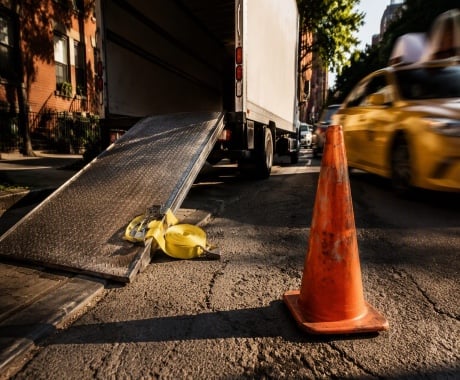
1. Decide Where to Park a Moving Truck in NYC
Position the truck in a legal curb space as close to the building as possible without covering a crosswalk, hydrant, driveway, bus stop, bike lane, building entrance, or marked no-standing area. Read every sign that applies to that side of the block before unloading. This is central to deciding where to park, and it takes only a few minutes.
Read the Entire Curb Before Committing
NYC parking restrictions change by time of day and street-cleaning schedule, and they can differ by vehicle type and block segment. The driver should walk the block and read signs in both directions. Never assume the truck parked ahead of you got it right. Check the current NYC DOT parking regulations before relying on any specific distance or exception.
Prefer a curb position on the same side as the building so nobody has to cross an active travel lane. Hazard lights don’t authorize illegal parking, and a rental truck may not qualify for every commercial loading exception. If the block can’t legally host the truck, arrange a different loading time or ask NYC DOT about an authorized curb-use option.
Check the Loading Path Before Opening the Truck
Walk the full route between the truck and the apartment before opening the rear door. Look for cellar doors and tree pits, watch for uneven pavement, and note any building doors that swing into the path. Do not unload until the truck is stable, the parking brake is set, and the loading surface is ready. If you use a ramp or liftgate, follow the truck company’s instructions and keep the equipment inside your controlled work area.
Treat Bike Lanes as Active Traffic Lanes
A painted bike lane is not spare loading space. Neither equipment nor people belong in it. If the carry route crosses a bike lane, the spotter must control the movement without pushing cyclists into vehicle traffic.
2. Mark a Safe Temporary Loading Area
Create a temporary loading area by defining where equipment and people may work while preserving a separate walking route for pedestrians. Anyone asking how to create a safe loading zone should start with that boundary, because cones alone do not reserve public curb space or authorize anyone to block traffic.
Establish Three Functional Spaces
Think in terms of three spaces. The truck zone holds the ramp or liftgate. The carry path connects the truck to the building. A small staging point inside the property holds items that are ready to load.
Keep boxes inside the building until the truck team signals that there is room. A pile at the curb creates trip hazards and blocks the walking route.
Use Visible Equipment Without Claiming the Street
Use bright vests and clean cones when they help, and add portable warning lights only when the manufacturer’s instructions allow safe use. Skip improvised ropes stretched across the sidewalk. Never leave objects unattended in the roadway, and never ask a person to stand in traffic to hold a spot.
A cone communicates a hazard, not a permit. It does not change parking rules or claim the street.
3. Protect Sidewalks, Entrances, and Exit Routes
Keep the public sidewalk continuously passable, and leave every building entrance and fire exit unobstructed. Sidewalk clearance comes down to one test: if an item cannot move through without forcing another person into the street, pause and clear the route.
Maintain a Continuous Pedestrian Path
New York City sidewalks vary widely in width, so no single clearance number fits every block. Check the current city rules, any applicable permit, and the property conditions before setting up the route. Check the moving truck sidewalk clearance rules for the block, including current city requirements and any permit terms. Pedestrians should never have to step into a bike lane or the roadway because furniture or an open truck door blocks the sidewalk.
Use a Controlled Carry System
Move one large item through the narrowest part of the route at a time. The indoor team should wait until the outdoor path is clear. Never lean mattresses or mirrors against the building where they can fall into the walking route.
Protect People With Limited Mobility
Plan for neighbors who use wheelchairs or walkers and for people with low vision. Never direct a pedestrian into the street or beneath an elevated liftgate. If a stroller or service animal needs to pass, stop the carry and hold the item still until the path clears.
Keep Required Exits Clear
The practical rule is simple. Never stage furniture in a lobby or doorway, and never block a stair enclosure or required exit.
4. Assign and Brief a Spotter
A moving-day spotter watches traffic and pedestrians, keeps the carrying route clear, and stops the move when a vehicle or cyclist enters the conflict area. Using a spotter near traffic works only when that person stays dedicated to the job. Using a spotter while moving also requires every helper to recognize the same stop command. The spotter should not carry furniture, use a phone, or stand in an active lane.
Give the Spotter One Job
The spotter faces the direction with the greatest immediate risk while keeping the movers in view. If traffic approaches from several directions at once, pause the carry rather than asking one person to watch every conflict.
Agree on Simple Stop Signals
Pick one spoken command, such as “stop,” and one visible hand signal. Every mover freezes the moment that signal appears. Avoid complex gestures that someone carrying a sofa may misread.
Stop means stop.
Place the Spotter Where Drivers Can See Them
The spotter stands on the sidewalk or another protected spot with a clear view of the work area. Keep the position entirely out of the travel lane. The spotter should never confront a driver or try to direct an intersection.
Stop During Changing Conditions
If a delivery truck arrives, pause. If visibility drops or a school group approaches, pause. Resume only after everyone can see the full route again.
Rotate the Role
Fatigue dulls attention. Rotate trained helpers during a long move, and brief each replacement on the same stop command and standing position before they take over.
5. Load the Truck Without Creating a Street Hazard
Load large and heavy items first, secure each section before building the next layer, and keep the truck’s ramp clear of loose straps or packing material. Only the item being loaded should enter the curbside carry path.
Prepare Items Indoors
Disassemble bulky furniture and pad sharp corners inside the apartment. Secure drawers and doors before anything leaves the building. Check the rental company’s loading guide for truck-specific weight limits and tie-down instructions.
Keep the Ramp and Liftgate Controlled
Only trained adults should operate a liftgate. Keep feet away from edges and pinch points, and never exceed the manufacturer’s stated capacity.
Secure the Load in Sections
Place heavier pieces low and distribute weight as the rental company directs. Use the rated tie-down points inside the cargo box. Follow the truck’s instructions instead of a universal formula that might conflict with them.
Close the Work Area Before Moving the Truck
Account for every person, remove the equipment, secure the ramp or liftgate, and close the cargo door. Then complete a full walk-around before the driver pulls away. The driver should check both sides of the truck before starting the engine.
6. Follow NYC Hit-and-Run Victim Steps if a Driver Strikes Someone and Leaves
If a driver hits a pedestrian near the moving truck and leaves, call 911, request medical help, give the dispatcher the vehicle’s direction of travel, and preserve the scene without chasing the driver. Record what witnesses observed and identify nearby cameras as soon as the immediate danger has passed. These actions cover what to do after a pedestrian hit-and-run while responders are on the way.
Protect the Injured Person and Report the Crash
Stop loading immediately. Call 911 and request medical help. Do not move a seriously injured person unless another immediate danger exists, and follow the dispatcher’s instructions until responders arrive.
Under New York Vehicle and Traffic Law § 600, motorists involved in accidents causing personal injury must immediately stop and exchange required identifying information. Departing the scene constitutes a statutory violation. Victims and witnesses should never attempt to pursue a fleeing motorist.
Preserve Evidence Without Interfering With Care
Once you’ve helped the injured person, gather the details that fade fastest. Work through this checklist while memories are fresh:
- Write down the vehicle’s color, body type, damage, plate details, and direction of travel.
- Photograph the scene, including the truck’s position, debris, and visible injuries when appropriate.
- Collect witness names and contact details without coaching their accounts.
- Note nearby cameras, such as doorbell or storefront systems, and ask the owner to preserve the footage.
- Keep the police incident information, rental paperwork, and related receipts in one folder.
Skip social media. Do not post accusations or identifying information about the driver or vehicle, because public posts can complicate the investigation.
After the crash, the clock starts on two fronts: medical records and who pays when the driver is never found. This raises a practical question: what should you do if you’re a victim of a hit-and-run pedestrian accident in Queens? A victim has to document injuries, meet reporting deadlines, and navigate MVAIC coverage rules that are unfamiliar to most people before a crash.
Understand MVAIC Requirements
Some hit-and-run victims in New York may qualify for help through the Motor Vehicle Accident Indemnification Corporation (MVAIC). Eligibility is not automatic, and reporting and filing requirements may apply. Review the official MVAIC information promptly and confirm the requirements that apply to your circumstances.
Common Questions About a Hit-and-Run Near a Moving Truck
How do you report a pedestrian hit-and-run in NYC?
Report an injury collision immediately through 911. Give the dispatcher the vehicle description and direction of travel, request medical help, and obtain the police incident information from responding officers.
What proof should you preserve after a fleeing driver causes a crash?
Preserve the police incident information, medical records, photographs, witness contact details, and camera locations. Keep original files and documents together, and do not edit or discard potential evidence.
What can happen to a driver who leaves an injury crash in New York?
Consequences depend on the injury and the driver’s conduct. Vehicle and Traffic Law §600, cited above, contains the offenses and penalties for leaving a collision scene, including potential felony charges in specified serious-injury circumstances. The exact charge depends on the facts and the applicable subdivision.
Which evidence can prove a hit-and-run case?
A hit-and-run case may rely on police records, medical documentation, photographs, witness accounts, video footage, vehicle debris, and plate or vehicle details. Preserve original files and write down observations promptly so investigators can compare the evidence.
What penalties follow leaving a crash scene in New York?
Leaving a crash scene in New York can lead to criminal charges, fines, license consequences, and possible imprisonment, depending on the injuries and other facts. A driver must stop and provide the information required by law, and serious-injury cases can carry more severe consequences.
Can police visit a home after a lower-damage hit-and-run?
Police may come to a person’s home if a plate number, vehicle description, camera recording, or witness statement connects that person or vehicle to the crash. Whether they do so depends on the available evidence and the investigation, even when the reported damage appears minor.
How do DUI and leaving the scene compare?
Neither offense is automatically worse in every case because the potential charges depend on injuries, prior history, test results, and the driver’s conduct. A DUI and a hit-and-run can each bring serious criminal and license consequences, and a driver may face both sets of allegations after the same crash.
How long can a NYC hit-and-run investigation remain open?
There is no single investigation length for every NYC hit-and-run. Police may identify a driver quickly from a plate or video, while cases with limited evidence can take longer or remain unresolved as investigators review new information.
7. Clear the Curb Before the Truck Departs
The move is not finished when the cargo door closes. The coordinator should walk the sidewalk and street edge, picking up stray straps and packing material before the wind sends them into traffic. Check the building entrance and curb for forgotten cones too.
The driver then checks the mirrors and blind spots, confirms overhead clearance, and studies the route ahead. A spotter may help from a visible, protected position, but the spotter must never stand behind a reversing truck. The last cone goes into the truck before you release the parking brake.
A Safer Move Starts at the Curb
A safe move on a New York City block comes together when the truck sits in a legal curb position, the walking route stays open, and every carry stops the moment the spotter calls it. None of that requires special equipment. It requires a plan set before the first box leaves the building, and the discipline to pause whenever street conditions change.
We hope you found this blog post on How to Load a Moving Truck Safely on NYC Streets useful. Be sure to check out our post on 7 Misconceptions About Full-Service Moving Companies and What the Reality Is for more great tips!

Have Experience in the Moving Industry? Want an Additional Income Stream? Work With All Around Moving!
Partner with us, All Around Moving, and we’ll help you make money by establishing your own moving relocation consultant business. We share the profit 50%- 50%. Click here to learn more.