

Most relocation budgets have a line item for movers, for flights, for a security deposit, sometimes even for a settling-in allowance. Almost none have a line item for translation quality. Yet a single mistranslated clause in a lease, a customs form, or a visa application can outweigh every other cost on that list combined.
This is not a warning about awkward phrasing or lost-in-translation embarrassment. It is an economic argument: translation quality behaves like every other hidden cost in a relocation budget, cheap to fix early and expensive to fix late. A document caught and corrected before it is filed costs a few hundred dollars at most. The same error caught after a shipment is held at customs, a visa application is rejected, or a lease is signed can cost ten times that, plus weeks of delay.
This article walks through the international relocation timeline stage by stage, prices the realistic cost range of a translation error at each one, and shows where the return on getting translation right the first time is highest.
Key Takeaways
- A one-time professional review of relocation paperwork typically runs $150 to $400. A customs hold triggered by a single mistranslated shipping document can add $375 to $750 in demurrage fees alone, based on published per-day storage rates.
- Individual AI translation models mistranslate or hallucinate content between 10% and 18% of the time on translation tasks, according to industry benchmarking synthesized in Intento’s State of Translation Automation 2025 report.
- S. Citizenship and Immigration Services can delay or deny a case outright when submitted documents are not properly translated, according to American Translators Association guidance for applicants.
- Global financial losses tied to AI hallucination errors reached $67.4 billion in 2024, and enterprises now spend roughly $14,200 per employee annually just catching and correcting them, per Forrester Research (2025).
- The most expensive translation error in an international move is rarely the shipping form. It is usually the signed lease or employment contract, where a mistranslated clause can trigger legal costs running into the thousands.
In This Article
- Why Translation Belongs on the Relocation Budget, Not Just the Checklist
- Step 1: Pre-Departure Paperwork Is the Cheapest Place to Catch an Error
- Step 2: Customs and Shipping, Where Delay Becomes a Daily Invoice
- Step 3: Visas and Immigration, the Cost of a Second Filing
- Step 4: Housing Contracts, Where a Mistranslation Becomes a Legal Liability
- Step 5: Settling In, Schools, Insurance, and Employment Records
- The Verification Math: Why “Good Enough” Translation Costs More Later
- Building Translation Into the Relocation Budget: A Five-Step Framework
- Questions Readers Ask
Why Translation Belongs on the Relocation Budget, Not Just the Checklist
Translation shows up on almost every moving checklist, filed somewhere between “arrange visas” and “book flights,” as something to handle before departure. Treating it as a checklist item, rather than a budget line with its own cost-of-error calculation, is exactly what makes it expensive.
An international move generates documents across five categories: personal identification, shipping and customs paperwork, property and financial records, medical and education records, and employment contracts. As one guide to overseas relocation puts it plainly: “every mistranslated sentence adds friction, cost, and risk.” That statement holds up financially, not just practically, once you price out what the friction actually costs at each stage.
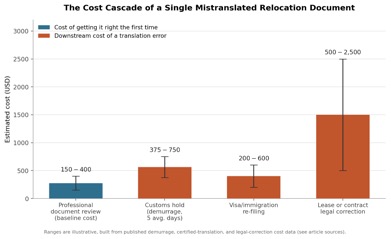
Figure 1. Illustrative cost ranges built from published demurrage, certified-translation, and legal-correction data cited throughout this article.
Step 1: Pre-Departure Paperwork Is the Cheapest Place to Catch an Error
The earliest stage of a move, gathering and translating identification, financial, and education records, is also the cheapest point at which to catch a translation problem, because nothing has shipped, been filed, or been signed yet.
At this stage, the documents typically in play include:
- Passports, birth certificates, and marriage certificates
- Bank statements and tax records needed for a mortgage, lease, or visa application
- Academic transcripts and diplomas for school enrollment or credential recognition
- Employment history and reference letters
A professional review of this document set, whether a certified human translation or a careful check of a machine-generated draft, typically costs between $150 and $400 depending on document volume and language pair. That is the cheapest correction point in the entire relocation timeline. Every stage after this one adds a delay cost on top of the correction cost.
Step 2: Customs and Shipping, Where Delay Becomes a Daily Invoice
Once a shipment is in transit, a translation error stops being a paperwork problem and starts accumulating as a daily invoice, because customs holds are billed by the day, not by the incident.
Incomplete or inaccurate translations on customs paperwork commonly add $75 to $150 per day in demurrage fees while a shipment sits at port. Demurrage charges accrue automatically once a container exceeds its free storage period, and clearing a hold caused by a documentation dispute rarely takes less than a few days.
Run the math on a typical five-day hold and a single mistranslated bill of lading, invoice, or packing list turns into a $375 to $750 charge that a correctly translated document would have avoided entirely.
Step 3: Visas and Immigration, the Cost of a Second Filing
A mistranslated or improperly certified document does not just risk rejection. It resets the clock on an entire visa or immigration filing.
The American Translators Association is direct about the consequence: “Submitting untranslated foreign-language documents could result in your case being delayed or denied.” For an international move tied to a job start date, a school term, or a lease start, a denial is rarely just an inconvenience. It typically means re-filing fees, another round of certified translation costs, and weeks or months of extended temporary housing while the case is reprocessed.
The upfront cost difference between a properly certified translation and a rejected one is small. The downstream cost difference, measured in weeks of delay and extended housing, is not.
Step 4: Housing Contracts, Where a Mistranslation Becomes a Legal Liability
A lease or property purchase agreement is where a translation error stops being an inconvenience and becomes a signed legal obligation.
This is also the point in a relocation where relying on a single machine translation, with no second check, carries the most financial exposure. A mistranslated payment term, renewal clause, or liability provision is binding the moment it is signed, whether or not either party understood it correctly. Understanding the true cost of AI translation on a document like this means looking past the price of the translation itself and pricing in what a contract dispute, a lease broken in error, or a misunderstood penalty clause actually costs to unwind.
Ofer Tirosh, CEO of Tomedes, frames the shift in how translation accuracy is being engineered this way:
“We’ve evolved beyond pure comparison into active composition, engineering systems that surface the most robust translation, not merely the highest-ranked candidate.”
In practice, that means the safest approach to a housing contract in a foreign language is a second, independent check, whether that check is a certified human translator or a system built to cross-verify machine output, before a signature goes on the page.
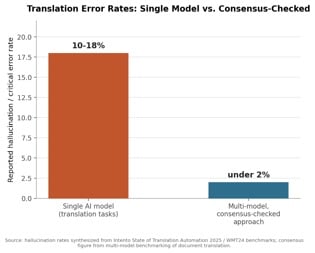
Figure 2. Reported error rate on translation tasks compared with a cross-checked, multi-model approach.
Step 5: Settling In, Schools, Insurance, and Employment Records
The costs do not stop once the shipment arrives and the lease is signed. Incorrect translations of school transcripts, health insurance policies, and employment contracts each create their own downstream bill.
- A transcript with mistranslated grades or course names can delay school enrollment by a full term, forcing families into short-term childcare or tutoring costs.
- A misunderstood exclusion clause in a translated insurance policy is often only discovered at the moment of a claim, when it is too late to fix.
- An employment contract with a mistranslated compensation, notice period, or non-compete clause can create a dispute that costs far more in legal fees than the original translation would have.
None of these are edge cases. They are the predictable result of treating post-arrival paperwork as lower priority than pre-departure paperwork, when the financial exposure is often just as high.
The Verification Math: Why “Good Enough” Translation Costs More Later
The economics only make sense once the error rates are on the table. Individual AI models, used without a second check, mistranslate or hallucinate content in 10% to 18% of translation tasks, according to benchmarking synthesized in Intento’s 2025 industry report. Approaches that cross-check output across multiple models before delivering a result report critical error rates under 2%.
The financial stakes behind that gap are not small. Forrester Research (2025) puts global losses tied to AI hallucination errors at $67.4 billion in 2024, with enterprises spending an average of $14,200 per employee annually and 4.3 hours per week just verifying AI-generated output. An individual relocating internationally does not have a compliance team to absorb that verification burden. The cost lands directly on them, in the form of delays, re-filings, and disputes.
| Approach | Reported error rate | Where the cost shows up |
| Single AI model, used as-is | 10% to 18% on translation tasks | Customs re-filing, visa resubmission, lease disputes, missed enrollment deadlines |
| Certified human translation | Near-zero on final output | Upfront cost only; standard for legal and immigration documents |
| Multi-model, consensus-checked translation | Under 2% on critical errors | Low upfront cost; scales across high-volume, lower-stakes documents |
Building Translation Into the Relocation Budget: A Five-Step Framework
Treating translation as a budgeted, risk-ranked line item rather than an afterthought is a five-step process:
- Inventory every document by risk tier. Separate legal, immigration, and financial documents from informational or low-stakes material.
- Budget professional or certified review specifically for high-stakes documents: leases, contracts, visa applications, and anything requiring a signature.
- Use a verified, cross-checked translation approach for higher-volume, lower-stakes material, such as correspondence or informal records.
- Build in a review buffer of several business days before any filing or signing deadline, so a caught error does not become a missed deadline.
- Treat the cost of translation review as insurance against delay, not as overhead. The comparison in Figure 1 shows why: the insurance premium is a fraction of the claim.
Questions Readers Ask
Does a mistranslated shipping document actually cause customs delays?
Yes. Customs authorities routinely hold shipments when bills of lading, invoices, or packing lists do not match or cannot be verified in the local language, and storage fees accrue for every day the shipment sits at port.
Is certified translation required for every relocation document?
No. Certified translation is typically required for legal, immigration, and financial documents submitted to a government authority or used in a signed contract. Informational material, such as personal correspondence, does not carry the same requirement.
Can a single AI translation be trusted for a signed lease or contract without any further check?
No. Reported error rates of 10% to 18% on translation tasks from individual AI models mean a second, independent check, human or cross-verified, is the safer standard before signing any binding agreement.
Is it cheaper to pay for translation review upfront or deal with problems later?
Upfront. A pre-departure document review costs a few hundred dollars at most. In contrast, a customs hold, a rejected visa filing, or a contract dispute caused by the same error typically costs several times that, plus weeks of delay.
The Bottom Line
An international move is, among other things, a sequence of documents that each carry financial consequences if mistranslated. The pattern holds at every stage: the earlier a translation error is caught, the cheaper it is to fix, and the cost of catching it early is consistently smaller than the cost of the delay, re-filing, or dispute that follows if it is not.
Budgeting for translation quality the same way you budget for movers or flights, as a planned cost rather than an emergency one, is what keeps an international relocation on schedule and on budget.